
Why I Emptied My Military TSP to Go All-In on Bryan-College Station Real Estate
This post details why a former military pilot withdrew $91,000 from their TSP to invest in Bryan-College Station real estate. It covers the strategy behind the move, the significant financial gains, the realities of property management, and how it evolved into a successful real estate business.

Greg Schwartz
August 5, 2026
Why I Emptied My Military TSP to Go All-In on Bryan-College Station Real Estate
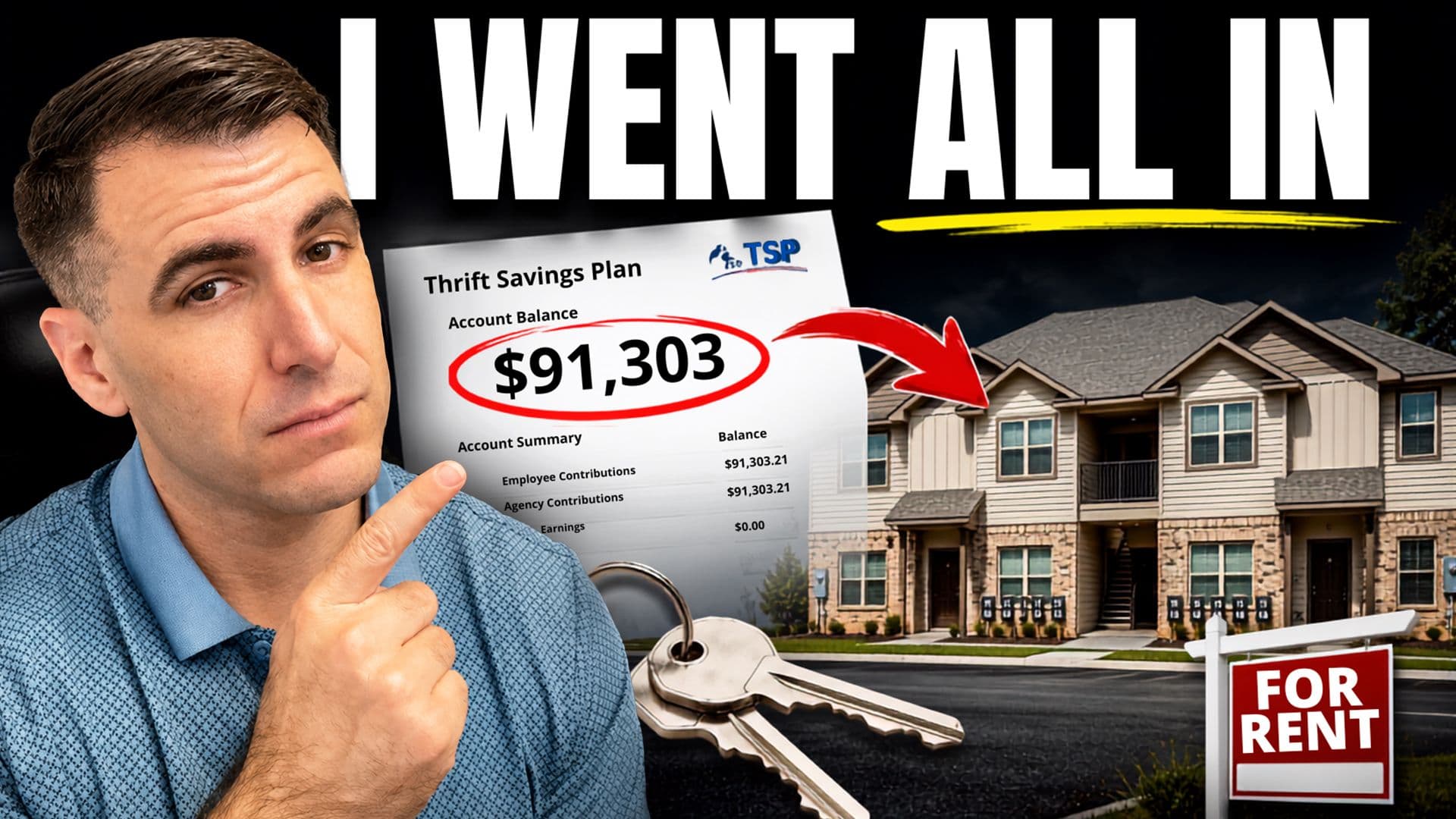
Five years ago, I pulled $91,030 out of my military Thrift Savings Plan (TSP). I decided to ditch my traditional retirement track and go completely all-in on real estate right here in Bryan and College Station, Texas.
With that money, I bought three fourplexes—a total of 12 units. Had I left that cash sitting in my TSP, it would have grown over the last five years to nearly $200,000. Instead, by putting it into Aggieland real estate, I grew that initial investment into a $350,000 equity position. That is a $150,000 increase over what the traditional retirement route would have given me.
Today, I want to share exactly why I made that leap, the five reasons I chose local real estate over a predictable retirement path, my single biggest regret, and what we've built since taking that massive step.
From Financial Nerd to House Hacker
To understand why I took such a big risk, we have to go back 16 years to when I was starting my career as a Marine Corps helicopter pilot. I was a good little financial nerd. Every single month, I faithfully pumped money into my military TSP (the military's equivalent of a 401k) and watched it grow. By the time it hit $90,000, I was feeling pretty good about being on a comfortable, traditional track to retirement.
But then, the real estate bug bit me.
I didn't immediately drain my retirement fund; I wasn't ready for that yet. Instead, when my wife and I moved from North Carolina to Texas, we sold our North Carolina house and used the proceeds plus some personal savings to "house hack". We moved into a local fourplex.
It was my first time being hands-on with owning and managing real estate, and it was a massive eye-opener. The property was a 1980s build with plenty of deferred maintenance. We dumped about $120,000 into renovating it, turning it into a place our tenants enjoyed living in and something we were proud to own.
I was officially hooked. Then, opportunity knocked.
When the Stars Align: The 2020 Pivot
In 2020, three distinct factors perfectly aligned for us:
- A Soft Multifamily Market: Much like the market looks today, the local real estate market was soft back in 2020. Multi-family properties were sitting on the market, and I spotted three fourplexes sitting on the exact same street that had under-market rents.
- An Investing Partner: My dad had been watching all the blood, sweat, tears, and ultimate success we experienced with our first fourplex. He decided he wanted to move some of his own traditional retirement savings out of the market and partner with us.
- The CARES Act Provision: Because of the COVID-19 pandemic, the government passed the CARES Act. It included a unique provision that allowed me to tap into my retirement savings early without the heavy financial penalties usually paired with draining an account at 32 years old.
I pulled the trigger and emptied $91,000 from my TSP. I had no other savings or investments left—everything was riding on our first house hack and this new 12-unit purchase.
Here are the five core reasons why I chose local real estate over a comfortable index fund.
5 Reasons I Chose Bryan-College Station Real Estate Over a Traditional 401k
1. The Power of Texas A&M and Aggieland
First and foremost, this market is home to Texas A&M University. We are talking about the second-largest university in the country with over 75,000 students and Kyle Field, a stadium that packs in 100,000+ people on game days.
On the surface, you might think relying on a single economic driver introduces risk. But because Texas A&M has an incredibly loyal alumni base that feeds into countless surrounding industries, our local economy proves to be remarkably recession-resistant.
2. Historical Market Consistency
Real estate always carries risk, but you can mitigate that risk by investing in a market defined by steady appreciation. When you look back at the last 20, 30, and 40 years of history in Bryan and College Station, you don't see extreme highs and volatile lows. It is a history of steady, reliable population growth, stable appreciation, and a consistently strong local economy.
3. Total Control Over the Investment
When I was pumping monthly cash into the TSP, my money was sitting in the C Fund (the common stock fund equivalent to the S&P 500). I had zero control over those corporations. I couldn't drive any value, improve the companies, or influence their decisions.
I like having control over my destiny. With a fourplex, I can roll up my sleeves, renovate the units, select the tenants, and directly drive the rental income upward.
4. Massively Flexible Tax Advantages
Traditional retirement plans certainly have tax benefits, but real estate gives you an unmatched playbook of strategic wealth-building options. If you live in a primary residential unit for two years, you can completely eliminate capital gains tax upon selling. For investment properties, you can utilize a 1031 exchange to defer your taxes completely, or leverage accelerated depreciation and cost segregation to slash your active taxable income.
5. Multiple Profitable Exit Strategies
As a former helicopter pilot, I was trained to constantly look for emergency landing zones ahead of me. You always want to be in a position where you have multiple safe spots to touch down.
Traditional stock investing essentially gives you two options: hold on tight through a crazy roller coaster ride, or sell. Real estate, if bought smartly, offers a handful of profitable exit paths. You can pivot the asset into short-term rentals, flip the property, take on an equity partner, refinance to pull cash out, complete a 1031 exchange, or simply sell it outright.
My Big Regret: The Reality of Real Estate Complexity
I don't want to sugarcoat it—I do have one major regret about making this move. By opting out of a passive index fund, my life became infinitely more complex, and I took on a massive level of day-to-day responsibility.
When you contribute to a 401k, you forget about it and let the market do the work. When you buy physical property, you are legally and morally responsible for providing a safe, functional place for real people to live.
Because I choose to self-manage our portfolio to capture outsized returns, that complexity falls directly on me. My wife and I handle the repairs, fill the unexpected vacancies, and deal with property management realities daily.
The Financial Payoff and What We've Built Since
Taking on that property management complexity has been entirely worth it. From a strict financial standpoint, my $91,000 investment is a $350,000 equity position today. (Remember, the TSP would have only left me with around $197,000 over that same timeframe).
But the rewards go far beyond my own net worth. Over the last five years, we have:
- Upgraded the Local Community: We fully renovated eight of those initial 12 units, significantly increasing the quality of the buildings on that street.
- Created Aggieland Lodging: We transitioned four of those units into Airbnbs, creating premium, comfortable places for families to stay when they come into town to visit Texas A&M.
- Expanded the Portfolio: Using the lessons from those 12 units, I went on to buy a highly profitable triplex just one mile from campus, a turnkey $300k duplex - a "1% rule" in Bryan that rents for $1,500 per side, and an owner-financed single-family home that has appreciated from $135,000 to over $225,000.
If you want to look at the exact numbers behind how multi-family properties cash flow and build long-term wealth, check out our Rental Property Calculator.
Helping Others Achieve the Same Success
The absolute best part of this entire journey has been scaling up Schwartz Realty Group. I’ve taken every ounce of personal, hands-on investing experience and used it to help our clients build their own paths to financial freedom.
We’ve helped clients secure dozens of duplexes—some landing as much as $70,000 under market value. We’ve guided everyday buyers through house hacking, helping them buy a duplex as their very first home instead of a standard single-family property.
We also work directly with Aggie parents who make the smart choice to invest in local student housing rather than throwing away money on rent while their kids are attending Texas A&M and working toward that coveted Aggie ring. If you're a parent weighing these choices for your student, try out our Aggie Parent Buy vs. Rent Calculator to see the numbers side-by-side.
Moving my funds out of that traditional TSP completely changed the trajectory of my life, business, and portfolio. I have never looked back.
Ready to Start Your Local Investing Journey?
Whether you are looking to secure your first house hack, find a steady cash-flowing multi-family asset, or buy a student housing property for your kids, we have the local expertise to make it happen safely and profitably.
Let's grab a coffee and talk about your real estate goals. Reach out to us directly at info@schwartzrealtygroup.com or head over to our local tools page to test out the numbers yourself!
About Greg Schwartz
Marine veteran and founder of Schwartz Realty Group
Free Real Estate Calculators
Run the numbers on a Bryan College Station property with our free tools.