
Why Furnished Rentals and Rent-by-the-Room Strategies Lose Money in Bryan-College Station (And the One Exception)
This post explains why furnished rentals and per-room leasing strategies often underperform for landlords in Bryan-College Station due to high costs and maintenance headaches. It also reveals the "Aggie Parent Strategy" as the rare exception that can actually boost annual rental revenue.

Greg Schwartz
August 21, 2026
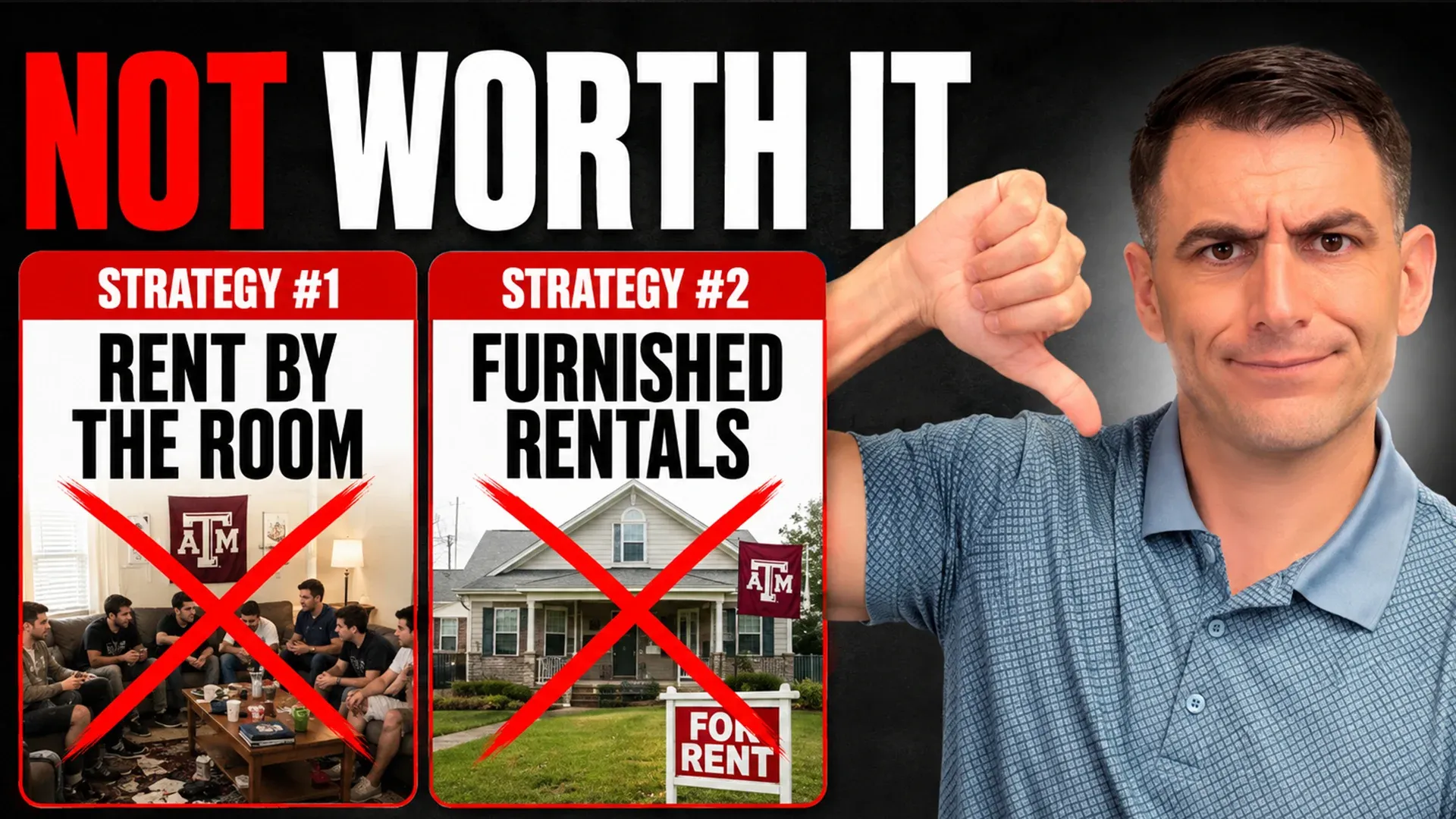
Why Furnished Rentals and Rent-by-the-Room Strategies Lose Money in Bryan-College Station (And the One Exception)
Before you spend an extra $5,000 furnishing a rental property here in College Station or trying to lease it out by the bedroom thinking you’ve unlocked a passive income cheat code, you need to stop.
The truth is this: furnished rentals and rent-by-the-room strategies don't just underperform. They usually lose money. In almost every single scenario, they just end up creating more complexity and massive headaches for you as a landlord.
Sure, on paper, you might look like you are going to make an extra hundred bucks or more a month. But that is before you factor in the real-world costs of broken furniture, high vacancy factors, and the sheer exhaustion of dealing with tenant squabbles.
I’m Greg Schwartz, a real estate investor and an agent who works with investors right here in Aggieland. I’ve been doing this for the last 6+ years, and I’ve learned the hard way what separates a truly profitable strategy from one that simply looks good on paper.
Let's break down the real math, the upfront costs, and the hidden headaches behind these strategies—plus the one "parent strategy" exception to the rule that actually does make an additional $3,600 a year.
The Furnished Rental Trap: Higher Costs, Less Demand
It makes total sense on paper initially, and it appeals to what we consider to be basic common sense.
Imagine you are looking at a traditional three-bedroom rental property in the Bryan/College Station area. If it rents out for $700 a bedroom, you are bringing in $2,100 a month—a pretty solid rent rate. Then you think, "Hey, if I put some nice furniture in there, maybe I can push the rent an extra $100 per bedroom, get an extra $300 a month, and take home an extra $3,600 a year!"
Here is exactly what you are missing with that math:
- High Upfront Capital: Properly furnishing a multi-bedroom unit is going to cost you anywhere from $6,000 to $8,000 upfront. And don't think you can cheap out on IKEA particle board stuff; it will fall apart immediately and cost you way more than it was ever worth.
- The Local Reality of Demand: Here is what no one talks about in the Bryan and College Station market: most tenants—even the Texas A&M students—already have their own furniture. They have their own beds, couches, and side tables. They don't want a place that is pre-furnished. Because you're forcing furniture on them, you drastically shrink your pool of potential renters, which leads directly to a higher vacancy factor.
- The Wear-and-Tear Expense: When the furniture breaks, guess who is stuck with the bill? You. Your tenants aren't going to have any idea how that living room couch snapped in half. They won't admit they partied on it or crammed 17 people onto it; they'll just look at you to fix it.
When you add up the increased vacancies, the ongoing furniture repairs, and the heavy upfront investment, that extra $300 a month completely vanishes. You're right back to breaking even, except now you’ve vastly increased the complexity of your asset.
My advice? Keep it simple. Leave it un-furnished, walk away with your steady $2,100 a month, and enjoy owning a great rental in a premier college town.
If you want to run the numbers on standard long-term holding strategies, feel free to analyze your cash flow projections using our rental property calculator.
The "Rent-by-the-Room" Nightmare: Who Pays for the Damage?
The next common thought investors have is to rent out a property on a per-room basis to maximize cash flow. Again, on paper, the money seems to back it up.
If you have a four-bedroom house and can get an extra $25 to $100 more per bedroom by leasing rooms individually, you are looking at pulling in an extra $100 to $400 more pure cash flow per month.
This strategy is absolutely great... until it isn't. Here is the reality of individual room leases:
1. Common Area Casualties
What happens when someone puts a giant hole in the living room drywall? When you write up individual by-the-room leases, the tenants are only going to claim responsibility for their specific bedrooms. The living room, kitchen, and hallways are shared common spaces. When you have to charge for damages the tenants will start pointing fingers.
Think of it like an apartment complex with a community gym or a pool room. If someone cracks a window in the gym, the complex has to cover it because there is no single tenant to blame. When individual roommates point fingers at each other over common area damage, you are the one left covering the repair expenses out of your own pocket.
2. Sudden Income Drops
If you have four separate tenants on four separate leases and one person decides to pack up and move out, your rental income for that room instantly drops to zero.
Compare that to putting all four roommates together on one joint lease. If one person leaves under a single cohesive lease, the remaining three roommates are legally responsible for covering the entire financial difference. Putting everyone on one lease completely protects your financial downside and forces the tenants to take on the responsibility of keeping the property whole.
3. Playing Landlord Referee
When you rent by the room to unlinked individuals, you essentially become an active mediator for roommate drama. If one tenant wants to throw a party in the common space while another is trying to study all night for an exam, they are going to call you directly to complain about quiet hour violations.
When they are all on one lease, their squabbles are their problem. When they are on individual leases, their lifestyle clashes become your daily headache. Ask yourself: is that emotional toll really worth an extra $100 or $200 a month? In my opinion, absolutely NOT.
The Aggie Parent Exception: Making an Extra $3,600/Year
Now, there is exactly one major exception to the rent-by-the-room rule. I see it happen time and time again with my real estate clients who are specifically buying condos, townhomes, or single-family houses for their own kids to live in while attending Texas A&M University.
For some reason, when your own son or daughter is the primary occupant, the roommate dynamics completely shift—and the financial returns increase significantly.
Generally, standard by-the-room models net an extra $25 to $75 a month, which gets eaten up by management headaches. But when your Aggie child lives on-site, two amazing things happen:
- Built-In Property Management: Your kid acts as your live-in eyes and ears. If someone puts a hole in the living room wall, your child is going to text you immediately and tell you exactly who did it so you can bill the correct person. It completely eliminates the common area liability loop.
- Premium Pricing Power: I don't know the exact psychological science behind it, but when your kid lives there, roommates are consistently willing to pay a premium—often an extra $100 to $150 more per month.
Let’s look at the real math on a four-bedroom Aggieland property using this strategy:
Scenario
Standard Market Rent Per Room
Aggie Parent Strategy Rent Per Room
Monthly Surplus (3 Roommates)
Annual Added Revenue
4-Bed College Station Home
$600 / month
$700 / month
+$300 / month
+$3,600 / year
By moving your student into one room and renting the other three rooms out to peers, you pull an extra $300 a month in pure cash flow while maintaining an on-site manager to protect your asset. In this specific scenario, I 100% recommend utilizing a rent-by-the-room model.
If you are a parent looking at purchasing a property for your student attending Texas A&M, you can map out your exact financial comparisons using our specialized Aggie parent buy vs. rent calculator.
Ready to build a smart, high-performing real estate portfolio in Aggieland without the hidden traps? Reach out to our team directly at info@schwartzrealtygroup.com to find your next investment property.
About Greg Schwartz
Marine veteran and founder of Schwartz Realty Group
Free Real Estate Calculators
Run the numbers on a Bryan College Station property with our free tools.