
The Passive Income Lie: How to Build Real Wealth in Bryan-College Station Real Estate
Debunks the "passive income" myth in real estate, arguing that cash flow is an active side hustle. He emphasizes that real wealth comes from long-term market appreciation and advises investors to focus on scaling a portfolio of long-term rentals in the Bryan-College Station market.

Greg Schwartz
August 13, 2026
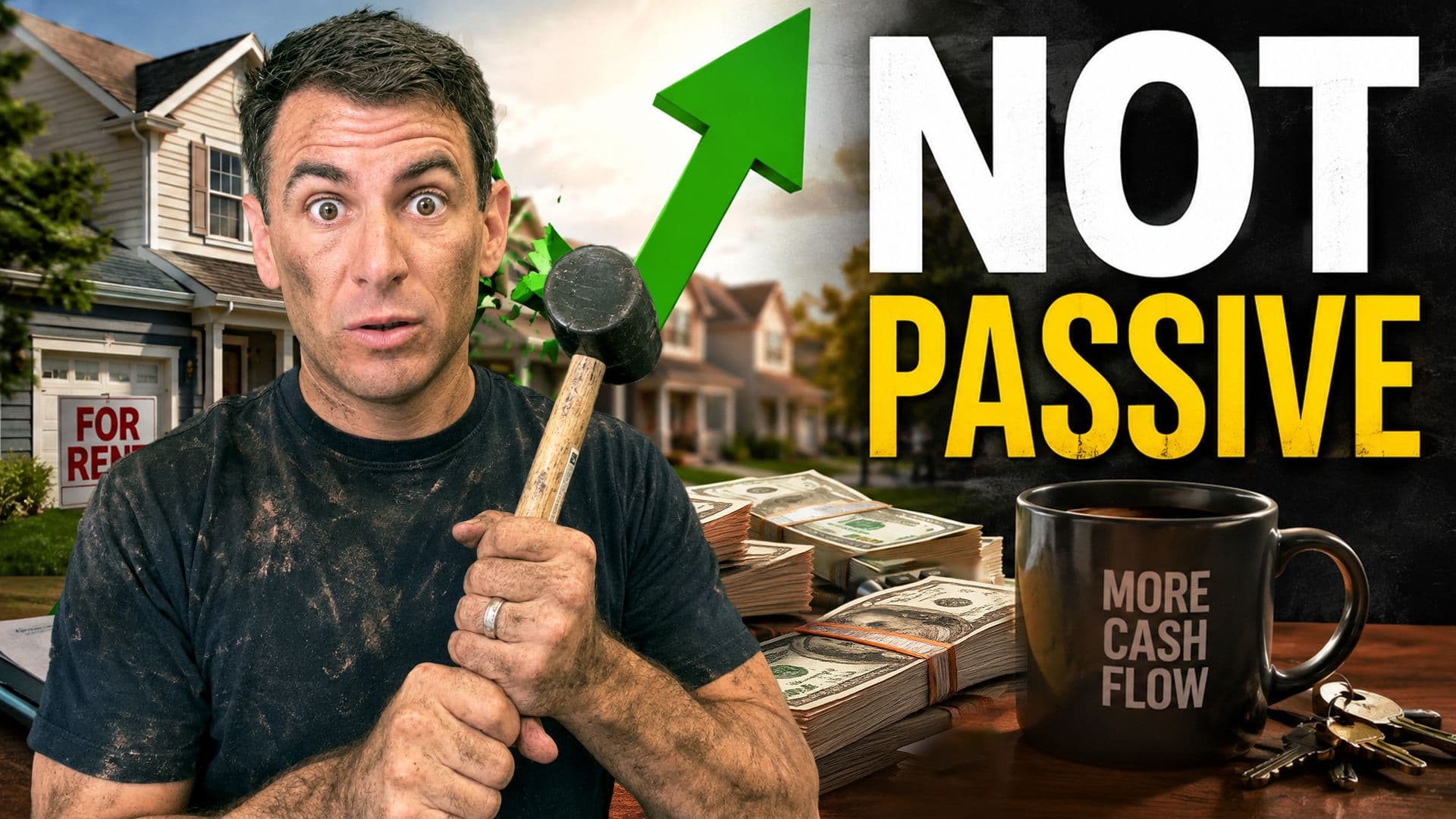
The Passive Income Lie: How to Build Real Wealth in Bryan-College Station Real Estate
Real estate investors, if you are obsessing over monthly cash flow, you are completely missing the only true passive wealth builder in this game. I’m Greg Schwartz. I’ve been investing for 8 years, and I currently self-manage 25 rental units right here in Bryan and College Station, all while running an investor-focused real estate agent business.
In this post, I’m going to break down the TikTok lie of passive income. I’m going to explain why cash flow is really just a side hustle and show you the exact math of how a basic $250,000 house can actually build massive wealth. By the end, you’ll know why building a portfolio of five to maybe 15 long-term rentals is the ultimate part-time job.
The Brutal Truth About the "Passive Income" Myth
You’ve seen them—the TikTokers and Instagram gurus showing off their rented Lamborghinis and bragging about their real estate portfolios that make them $250,000 a year while they sip Aperol Spritzes on the Amalfi Coast. They call it passive income. I'm calling BS.
I’ve tried almost every strategy out there. I’ve house hacked, done Airbnbs, long-term rentals, live-in flips, and owner financing. I’ve looked into wholesaling and subject-to. And here is the brutal truth that nobody tells you when they sell you their course: a physical piece of real estate is inherently active.
Think about it. If you buy a house here in College Station and let it sit totally empty, what happens? The house falls apart and you bleed money.
You have active expenses to pay:
- Property Taxes: We all know this is no joke here in Texas.
- Insurance & Utilities: Constant monthly drains on your wallet.
- Maintenance: Even if nobody is living there, the harsh Texas weather is going to age the roof, the siding, and the HVAC.
Suddenly, your "passive asset" has very active expenses. To stop the bleeding, you have to generate income to offset those holding costs. The moment you start generating income to cover those expenses, congratulations—you just bought yourself a side hustle.
Choosing Your Real Estate "Side Hustle"
Once you realize that cash flow is actually just a wage that you earn from a side hustle, you have to look at the different "jobs" you can choose to offset your property's expenses.
Job 1: The Long-Term Rental
Let’s say you self-manage a long-term rental property. It might cash flow $100 a month, and it takes you about an hour a month to manage. Effectively, your side hustle pays you $100 an hour. That's not a bad gig.
Job 2: The Short-Term Host (Airbnb)
This is the sexy strategy right now. Maybe you turn a house into an Airbnb rental and cash flow $500 a month. But wait—you are managing cleaners, dealing with rowdy Aggie tailgaters, answering midnight messages, and battling with Airbnb claims and support staff.
You easily put in 4 hours a month or more, which adds up to about 40 hours a year per unit. Do the math: $500 a month divided by 4 hours means you’re making only slightly more per hour than the long-term rental, but you're putting in four times more of your valuable time.
Let me pause right here and talk to the high-income earners. If you're making $250,000 or $300,000 a year in your main career, why on earth are you running an Airbnb for cash flow? If you want an extra $1,000 a month, go work a few extra hours at your high-paying, highly stable W2 job. Running a hospitality business on the side is a terrible trade of your time.
What About Flipping or Wholesaling?
I'm going to be real with you. Flipping is 100% an active job, and wholesaling is a 100% active hustle—no different than my real estate agent business. Because there is zero long-term ownership, there is no time for appreciation. In my opinion, that means zero passive wealth.
What True Passive Income Looks Like: The Aggieland Math
So, if cash flow is an active side hustle, what is the actual passive income in real estate?
It’s natural market appreciation.
It’s the kind of appreciation your dad got by buying a house in Austin back in 2000 and just sitting on it while the city grew around it.
Let’s look at the real math here in the Bryan-College Station market using our Rental Property Calculator:
- Purchase Price: Buy a basic, median-priced $250,000 house.
- Down Payment: Put down $50,000.
- The Growth: Based on historic averages since 1990, that house will appreciate by 4.5% to 5% per year.
- The Return: That amounts to $10,000 to $12,500 in wealth generation every single year.
Let that sink in. You might only be making $1,200 a year in active cash flow from your tenants, but your wealth just grew by over $12,000 without lifting a single finger. That is true passive income.
The Power of Scale: 2 Airbnbs vs. 8 Long-Term Rentals
Let's look at how this changes when you scale your portfolio.
Imagine you decide to run two Airbnbs. You'll make maybe $1,000 to $2,000 per month in active side hustle income, but you’re working 8 hours a month dealing with guests. You get the appreciation on those two houses, which adds up to 5% of a $500,000 portfolio.
Now look at the alternative. For the exact same amount of time—roughly 8 hours per month—you could manage eight long-term rentals on the side.
At $100 a month each, you make slightly less in active monthly side hustle income ($800/month). But because you hold eight assets instead of two, you are getting $80,000 a year in pure, passive appreciation.
Strategy
Hours Worked / Month
Active Side Hustle Income / Month
Portfolio Value
Annual Passive Appreciation (at 5%)
2 Airbnbs
~8 hours
$1,000 - $2,000
$500,000
$25,000
8 Long-Term Rentals
~8 hours
$800
$2,000,000
$80,000
Same hours worked, but a massively different trajectory for your passive wealth.
Shifting Your Scorecard: Cash Flow is the Shield, Not the Goal
This realization changes everything about how you should build a real estate portfolio. A lot of investors get completely paralyzed. They look at a local Bryan or College Station deal, see that it only cash flows $50 a month, and walk away because some online guru told them they need to be making $500 a door.
Stop looking at monthly cash flow as your scorecard.
Instead, look at cash flow as simply the shield that protects your asset. The only purpose of cash flow is to make sure the property is completely self-sustaining so that the government doesn't take it for unpaid taxes and the bank doesn't foreclose on you.
If the side hustle of cash flow pays the expenses, you get to keep the real estate longer. And the longer you keep real estate in a growing market like Bryan-College Station, the richer you get.
Your Real Estate Game Plan
The ideal blueprint for building wealth while working a demanding W2 career looks like this:
- Target a portfolio of 5, 10, or 15 long-term rentals right here locally.
- Self-manage them efficiently using tight, automated systems to keep your expenses low.
- Track your net worth every single year instead of stressing over monthly cash flow statements.
Managing a portfolio on the side doesn't have to be a nightmare. If you are ready to graduate from chasing minor cash flow to building actual, long-term wealth in the Bryan-College Station market, let's connect.
Shoot me an email at info@schwartzrealtygroup.com with the word "START" in the subject line. I’ll personally respond, and we’ll get a customized investment game plan built for you.
Sources:
About Greg Schwartz
Marine veteran and founder of Schwartz Realty Group
Free Real Estate Calculators
Run the numbers on a Bryan College Station property with our free tools.