
Single-Family Homes vs. Duplexes: The Hidden Real Estate Traps in Bryan-College Station (2026)
In the 2026 Bryan-College Station market, investing in a newer single-family home often outperforms an older duplex. This post exposes the hidden operational costs and the "multi-door illusion" that make single-family properties a smarter, more efficient investment choice for first-time buyers.

Greg Schwartz
September 26, 2025
Single-Family Homes vs. Duplexes: The Hidden Real Estate Traps in Bryan-College Station (2026)
Every first-time investor I talk to here in College Station, Texas, tells me the exact same thing: "I want a duplex. Two doors means more cash flow."
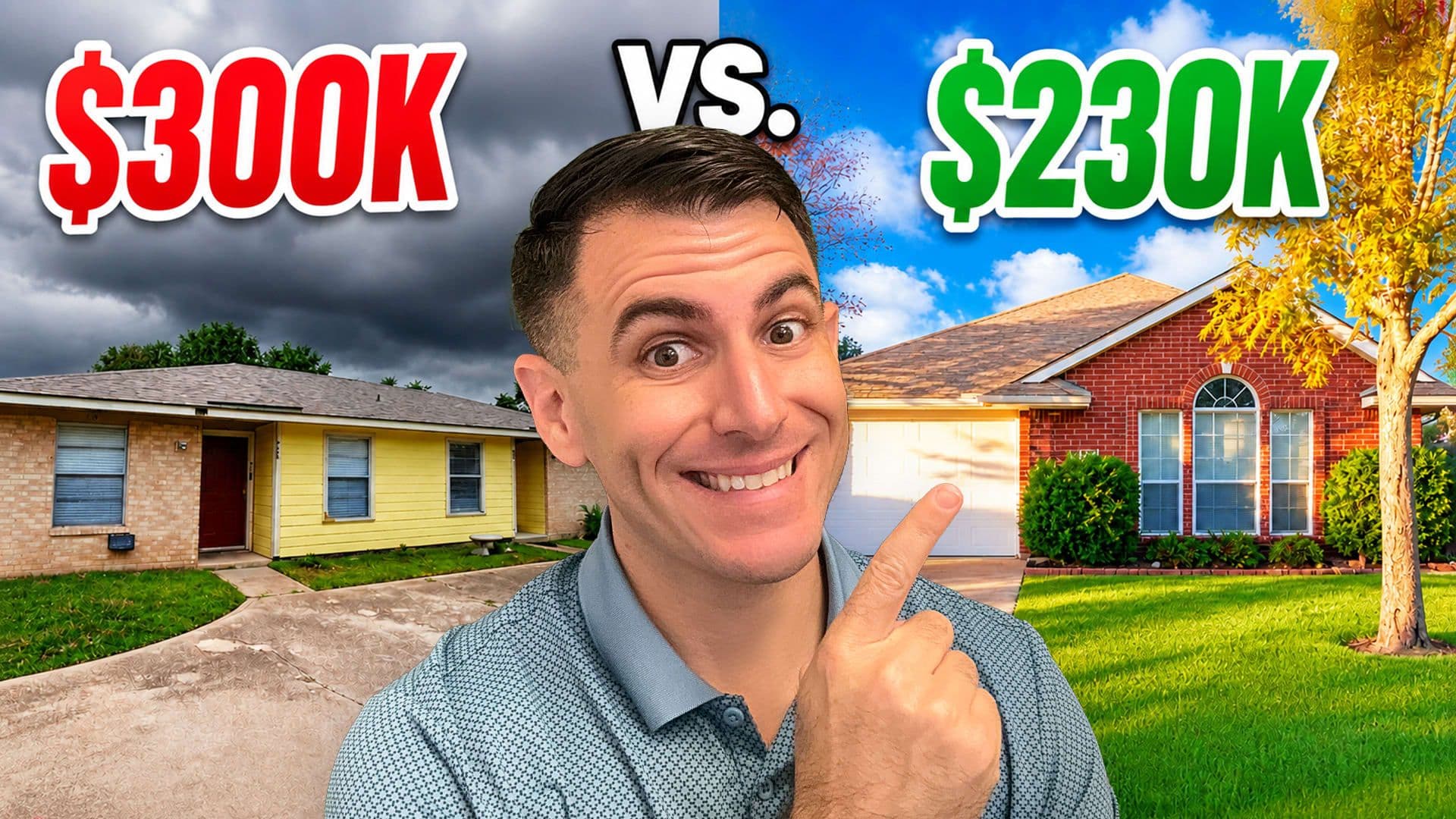
It sounds great on paper, but dropping $300,000 on an old duplex right now is an absolute trap. What if you could grab a newer single-family house in the sweet spot of $245,000 instead? It will be 20 years newer, easier to manage, and highly efficient.
I own both single-family homes and duplexes right here in the Bryan/College Station (BCS) area, and I help investors analyze these properties every single day. Let's stack a classic local 1980s-built duplex up against a 2000s-built single-family house to expose the real-world operational costs and hidden structural expenses that paper spreadsheets completely ignore. By the time we run the metrics, you'll see exactly why single-family houses are the better investment nine times out of ten for first-time investors in Bryan and College Station in 2026.
The BCS Playing Field: Two Asset Profiles
If you're hunting for an investment property in BCS right now with a budget of $300,000 or slightly below, your choices generally boil down to two specific assets:
1. The Classic 1980s-Built Duplex
You see these scattered all over BCS, particularly in the older student pockets of College Station and certain areas in Bryan. They are almost always side-by-side setups featuring two bedrooms and one to two bathrooms per side. On average, they run about 800 to 1,000 square feet. While they look standard on the outside with traditional Texas brick veneer, the interiors are usually in their original 1980s condition.
2. The 1995 to 2010-Built Single-Family House
This is the suburban sweet spot. We’re talking about a clean, three-bedroom, two-bath house with a legitimate two-car garage and roughly 1,100 to 1,400 square feet of space. Exterior finishes usually consist of brick and durable Hardy Plank siding.
Beware the "Multi-Door Illusion"
Why do most first-time investors immediately lean towards the duplex? It’s because of a psychological trap I call the multi-door illusion.
Every real estate forum and rookie podcast drills into your head that multifamily is always superior because two doors are better than one. Your brain looks at a duplex and says, "Man, if a tenant leaves, I still have one side paying the rent and covering the mortgage. It feels like built-in scale and instant protection."
On a clean white spreadsheet, that logic makes sense. But your spreadsheet doesn't manage actual human beings, and it doesn't operate the physical asset.
Cold Hard Facts: The Math vs. Reality
Let's look at how these properties actually stack up side-by-side in the 2026 market:
- The Duplex: You purchase it for around $280,000 and put $10,000 into each side to fix it up, leaving you all-in on an asset worth around $300,000. Once fixed up, it rents for about $1,200 per side, generating an income of $2,400 a month. This represents a 0.8% rent-to-price ratio, which is quite strong for our local market.
- The Single-Family House: You buy it completely all-in for $245,000, and it rents for around $1,900 a month. This gives you a 0.78% rent-to-price ratio.
On paper, the duplex wins a slight victory. But don't rely on back-of-the-napkin math or hiding spreadsheets. To analyze this properly, you need to plug these figures into a professional tool like our online Rental Property Calculator to see the true operational picture.
4 Hidden Profit Killers of 1980s Duplexes
When you factor in real-world expenses, the single-family home quickly overtakes the older duplex due to several critical operational factors:
1. High Upfront Capital Outlays
To pull in the quality of tenants you actually want living in your property, a 1980s duplex requires work. You have to update worn-out interiors, dated cabinets, old flooring, and that classic 1980s beige paint. That's an immediate $20,000 cash hit on day one ($10,000 per side). Conversely, a 2000s single-family home typically only needs a light refresh costing $5,000 to $10,000 max for the entire property—half as much cash out of pocket.
2. The Shared Utility & Maintenance Trap
Many 1980s-built duplexes in Bryan-College Station are not submetered for water, meaning you as the landlord often have to foot the entire utility bill. Furthermore, duplex tenants almost never cover the lawn care. That tacks on an extra out-of-pocket expense for you, usually averaging around $100 a month.
3. Rapid Tenant Turnover
The ultimate silent profit killer is tenant retention. Single-family houses attract long-term tenants who historically stay twice as long as duplex tenants. Less turnover means fewer vacancy periods and dramatically lower make-ready expenses, saving you thousands of dollars over a 5, 10, or 15-year holding period.
4. The "Shared Wall Tax"
Managing a multifamily property is naturally more complex due to the shared wall. I call this the shared wall tax because it's a tax on your time and patience. As a self-managing landlord, you will inevitably find yourself arbitrating neighbor squabbles over shared sounds, smells, and late-night parties.
If you decide that headache isn't worth it and hire a property manager, it will instantaneously cost you 10% of your gross rent—which translates to an unbudgeted $240 a month off your bottom line. Duplexes are flat-out harder to manage than single-family homes.
Conclusion: Why Single-Family Wins in 2026
Normally, a duplex creates enough additional cash flow compared to a single-family house to make the extra headaches worth it. But today, our local single-family housing market is much softer than the duplex market, which has compressed the pricing ratios and made them incredibly close.
When you look past basic rent-to-price ratios, break down real-world expenses, and factor in that a single-family home gives you an asset that is 20 years newer, buying a single-family home makes significantly more sense for your portfolio.
Ready to start or expand your investment journey in Aggieland?
Don't run your numbers on the back of a napkin. Put our free Rental Property Calculator to work today.
Want to line up a strategy call? Shoot me a text or call 443-812-0357.
About Greg Schwartz
Marine veteran and founder of Schwartz Realty Group
Free Real Estate Calculators
Run the numbers on a Bryan College Station property with our free tools.